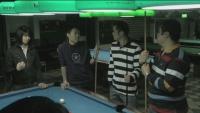
Anteprima di Giallo a Milano a Vado (BO)
- When
- Where
- Milan
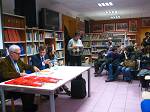
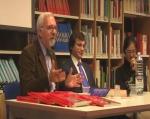
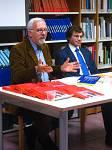
Vado (BO) - 29 Nov 2009 A Sunday afternoon led by professors Giorgio Mantici, Daniele Cologna and director Sergio Basso, in memory of the late Domenico Strangio. Also present was the vice consul in Milan He Fengyun.
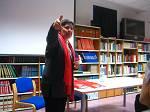
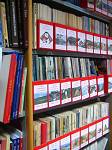
Since 2007 - the year the Chinese book archive was inaugurated - Elisabetta Monti has renewed this winter gathering, to keep alive the flame that drove her husband on those incredible journeys to China, and that natural humility in working in the Asian market with Luigi in his father's shop, Sun Ming Chuan (who recently passed away on 17 September 2009).
The afternoon's starter was a preview screening of the documentary "Giallo a Milano" by Sergio Basso - which took part in the Turin film festival.
I don't want to reveal too many details: the word "Giallo" (yellow) can refer disparagingly to the Chinese - or to the crime/detective genre. Milan is the perfect setting on Italian soil: it boasts the oldest community in Italy (the Chinese came from countries beyond the Alps such as France and England around the 1920s), it hosted the 2007 protest in via Paolo Sarpi and cases of murder. A film that weaves together both public events and private stories. As usual the subtitles help the audience without stealing the scene from the emotions and feelings that ooze from the protagonists' voices.
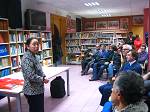
The saying sums up the essence of reality: one Japanese alone is a little worm, put 10 Japanese together and they form a dragon. One Chinese alone is a dragon, put 10 Chinese together and they are little worms. Angelo Ou in the film, after a nice nostalgic tour of Paolo Sarpi, ends with - 18 Chinese associations in 2009. This is the real defeat. Where is the unity? Lots of little dragons breathing fire on their fellow countrymen, networks of friends, relatives and colleagues all pointing to a single epicentre, the head dragon of that association. No mafia, guys - this is pure human egocentrism.
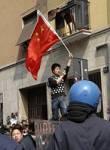
And remember that the Paolo Sarpi events were highlighted even in the motherland for just one tiny detail, as Cologna points out: the Chinese flag was displayed, cheered, and finally trampled in the frenzy, also by the municipal police. Shots, photos and videos flooded the web with these images. People talked about the gesture, but not about the facts or the problems. In 2009 nothing decisive has yet been done, partly due to the economic crisis on the world's stock markets. But never mind, the ViviSarpi committee does not give up; it appears in the documentary and, between massaging the back of an eighty-year-old and the feet of her neighbour, they ask "But don't you Chinese ever die? Where do you end up when you die? What do you put in spring rolls?". I don't expect them to visit the Associna website; clinging to these fears hides another great fear, common to all of us. Sergio Basso says it frankly: "A neighbourhood committee made up mostly of pensioners - of course it doesn't like seeing the place where it lives change. But this is absurd, otherwise we wouldn't have buildings like those of the 1992 EXPO in Barcelona. These people don't accept change because accepting it means they are getting old."

Clear? Good, plenty of opinions came up. I can't wait to hear from those directly involved. This is a documentary that stirs the masses. Daniele Cologna mentions the case of the hundred or so homeless Chinese in Milan, and the audience is unprepared for this reality. The much-vaunted solidarity of the Chinese community comes back to us like a glittering crystal: fragile, false and ephemeral. Another cliché to debunk, and those 18 Chinese associations in Milan come back to mind...
It's bad to stand still. Luckily young people have always been the hope - just look at the growing number of bright minds at Bocconi and Luiss in Milan and Rome - not to mention the other Italian universities. And Associna? In the last year it has had the good fortune of interacting with other young Chinese.
Francesco Saverio Wu, Fausto Huang, Hu Fangmei , Hu Qilin and Lin Jie are not afraid to appear in front of the cameras for a just cause; they believe they can make a difference in these challenges "against prejudice" and "easy labelling". Others are afraid, or invent excuse after excuse, an Italian vice learned at school. But what can I say, I'm almost 22, yet I already think I'm making a difference in my small way; there is nothing to lose, all we do is complain. Just imagine if 10 more people my age took the courage to improve and overcome all these flaws of the Chinese community in Italy.
I feel a sense of shame, of inferiority in the society that matters: historically the Chinese Government's funding prefers to go to the diasporas in England, France, Canada, America, the Netherlands and Germany, rightly motivated by their solid economic tradition. And perhaps Spain could even kick us out of the last places - although the latest financial crisis of 2010 reshuffled the cards in the Eurozone. Why don't they invest in Italy? Lack of economic and social solidity. Economically only Giupel is a head that votes at Confindustria congresses. In fact all the other Chinese Scrooges richer than him boast every time they return to China, knowing they don't count for much on the Italian national stage. Second point, Italy gives no political weight to foreign communities, and therefore not to the Chinese one either.
I'm sure it is extremely hard and impossible to change our parents' attitudes with their associations. The only chance is ourselves: but I see other young Chinese founding other associations for the pleasure of being "Mr President", some running beauty contests or Texas Poker gatherings, others throwing themselves headlong into work amid trips, dinners and meetings between Italy and China. What cultural value will we pass on to our little brothers or nephews, those born from the '90s onwards, the next young Italian-Chinese adults?
Being in Associna - makes a difference. Showing journalists that there are Chinese who speak Milanese, as Basso says, can shake the closed minds of fleets of pensioners. It takes little to cause a positive stir. With a scoop like that, it is possible to ride the wave of a mini-success: giving value to those with journalistic skills and becoming the community's expert, another doing sports reporting like Yoon C. Joyce , the Korean-born actor from Bergamo on Gene Gnok Calcio Show, another becoming the most sought-after lawyer in Italy. This is not a virtual stage, this is reality. Being there and being visible sets good examples for the kids studying for tomorrow; it gives you that adrenaline to redeem yourself and dream, like becoming a Gambero Rosso chef or the next player on the Italian national football team.
Bocconi or Luiss lets you make friends in the world that matters, among top entrepreneurs. For the Chinese this is better known as 面子 mianzi, making a face, a reputation. But if young Italians are already at each other's throats for the executive posts that the over-60s cling to, glued to their seats - I think only crumbs will be left for the Italian-Chinese. It is pointless to wave your degree like a flag if, just round the corner as you leave your office, they shout "yellow face" at you without love or respect. I think Marco Wong is living proof of how many pebbles he has had to remove from his shoes, and that the flame of hope must be kept alive against all odds. The extra card to play is bilingualism, as well as our flexibility at work and our background - understanding two or more cultures. "吃苦 Chi ku", eating bitterness, is what makes us different: we had difficult childhoods, unlike our Italian classmates, we know what it means to rise out of poverty.
It is fortunate to know that the written and oral memory of the post-war period has not been lost; heart-rending events from both the Italian and Chinese past resurface thanks to books and above all to films, and there is no need to repeat such ignoble inhumanity in 2010. We are a generation that is still fairly healthy and growing strongly, but it is easily trading ethical values for the luxury of designer bags and high-fashion clothes: some of our parents raise us to spend, others to study, but nobody explicitly tells us to be happy or to follow our dreams. The only possible best teachers of life are ourselves, our friends, our older brother or sister who more than anyone knows what it means to toil in pursuit of serenity. Wake up, guys, in twenty years it may be too late; if Sergio had to make a film like this, it means there are problems of inter-generational and intercultural communication. You don't become Italian overnight, but it takes just a moment to stop feeling at home.
Sun Wen-Long
Videos of the event: 1 | 2 | 3 | 4 | 5
Giallo a Milano
Fiume Giallo Archive in Vado (BO)