
Bologna: Associna and MIER
- When
- Where
- Bologna
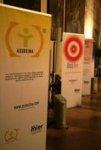
MIER and Associna, worlds that intersect, touch and engage with each other, over two intense days of debates, round tables, talk shows and interviews.
12–13 December 2008 - Bologna. “Ad Alt(r)a Voce” is the name of the event in which Associna took part, alongside many other organisations whose protagonists and themes are the non-Italian population of Italy.
Promoted by COSPE (Cooperation for the Development of Emerging Countries) with the support of the Emilia-Romagna Region and under the patronage of the Municipality of Bologna, the first gathering of MIER, the Meeting of Intercultural Media of Emilia-Romagna, proved to be clear and tangible evidence of the great richness and freshness that growing multiculturalism brings to Italy. Intercultural media include a great many newspapers, websites and radio programmes that give young people of foreign origin in Italy the chance to represent themselves, a space in which to express themselves, share their opinions and counter the misinformation provided by the mainstream media: to make their voice heard "Loud and Different".
The two days featured talks by many members of MIER, including the representative of Associna in Bologna Sun Wenlong, university lecturers, journalists and local authorities. The event opened with a speech by the deputy mayor of Bologna, Adriana Scaramuzzino, who emphasised the importance of investing in young people and creating a society of equal opportunities: “Knowing your rights leads to awareness, and consequently to knowledge of your duties; only in this way can we reach an equal, inclusive society in which prejudices and stereotypes are overcome”. On these premises the round table began, with discussion following two main threads: the right of foreign citizens to self-representation in order to build an “ultra-Italian” identity, and the comparison between intercultural media and mass media, which are often characterised by stigmatising language towards foreign citizens.
The second day began with the sweet notes, in Douala, of Alex Nkuin, a young man from Cameroon with a great voice who drew the whole audience into a big chorus, singing together “Dipita”, meaning “Hope”. In the Farnese Chapel of Palazzo d’Accursio, Radio Asterisco, a radio station with an intercultural editorial team, interviewed the representatives of MIER live. Among the many contributions, that of Sun Wenlong stood out, receiving warm applause and approval from the audience. In his speech he described the great richness of the emerging
Italian-Chinese culture, represented above all by young people, in whom a sort of union has taken place between the two traditions, that of their Chinese parents and that of their adopted homeland: “We are Italians too… but what for Italians often represents the different, the unknown, the mysterious, is for us normality and everyday life”.
Like the other intercultural media, therefore, Associna has a lot to offer precisely from this point of view: not only counter-information, but also information about who we are, what we do, and the reality and everyday life of being Italian-Chinese. “After all, communication is not only directed towards the outside world, but also towards ourselves, and one defines one's identity not through negations, but on an independent basis”, says the editor of “Il Tamburo”, Raymond Dassi.
This is precisely the principle on which “migrant publishing” must be based, in order to last over time and to begin putting down solid roots in the media world.
Sissi Lin