
Genoa, Associna and the meeting with Minister Ferrero
- When
- Where
- Genoa
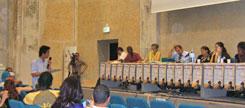
Saturday, June 23 - “Gridalo Forte!” (“Shout It Out Loud!”) is the title of the conference held at the Auditorium of San Salvatore in Piazza Sarzano, in the splendid city of Genoa. The second generations made their voices heard at a meeting organized by the University of Genoa.. (photos and videos)
“Gridalo Forte!” is the title of the conference held at the Auditorium of San Salvatore in Piazza Sarzano, in the splendid city of Genoa. The second generations made their voices heard at a meeting organized by the University of Genoa, the Centro Studi Medi and the Agenzia delle Ricerche Sociali of Milan. Answering the call was the Minister of Social Solidarity Paolo Ferrero. In addition to the two national second-generation associations, Associna and G2, many other associations active in Italy took part, including the Young Muslims Association, the Young Senegalese Association and the Latino Street Organizations of Genoa and Milan.
Associna members from all over Italy attended the event: from Padua the brilliant Cilex, from Milan the engineer Sefhy and aspiring journalist Shaoyan, from Rome the outgoing Lin, from Florence the feisty Silvia, from Bergamo the delightful Eva, from Treviso the wise Shehateme, from Bologna the smiling Cinciu, and from Genoa our host Nick. Thanks also go to the Chinese second generations of Genoa who took part, the lovely Elisa and the cultured Valeria. All of them showed great interest in this important event.
It was a meeting and an exchange, as well as an opportunity for dialogue among the various multiethnic communities of the Mediterranean peninsula. The event took place in three parts.
Part one: a direct face-to-face with Minister Ferrero
The topics were: the long waits to renew residence permits through the post-office procedure; the problem of student residence permits lasting at most one year, where Associna pointed out that the hardship of second generations raised in Italy arises on turning eighteen when choosing to continue their studies, because this choice would lead them to be treated as newly arrived foreign students, losing their right to national health care and taking on all the problems that come with a study permit; the obstacles to obtaining Italian citizenship and the long waiting times for those who have already applied; the right to vote for holders of the residence card; the difficulty young foreigners face in finding work; the problem of the CPTs; and the possibility for second generations to do civil service. Everyone saw citizenship as the solution to these problems, while a cry rose from the audience: “What is the Government doing?”, followed by long applause from those present.
Minister Ferrero promptly answered all the questions, seeking mediation and dialogue. First of all, the issue of the long procedure to amend the Fini-Bossi law, which should bring a turning point to the current situation; he blamed the obstructionism of the opposition for slowing the approval of the new bill, but assured that everything possible is being done. He stated that although he does not agree with the law of the previous legislature, “The government is obliged to respect the law, even if the law stinks!”, these were the Minister’s exact words.
The new bill will try to simplify the procedure for Italian citizenship and family reunification, permits will last longer, efforts will be made to improve the situation of the CPTs, and new migration flows will be introduced with the sponsor method and the introduction of self-sponsorship, a part considered doubtful by both the opposition and the coalition, but very important for the Minister, who states “The channels of departure for entering Italy are usually families and acquaintances”. The possibility of moving around all of Europe for work with just a residence permit will, however, only be possible after the European Union’s consent.
“It takes determination to build consensus!”, sighs the Minister. A very good piece of news is that the new budget law, already approved, has made 50 million euros available, which will be divided into 20 or 25 million euros for dismantling urban ghettos (for example: the 140 families in via Anelli in Padua), about 10 million euros for language courses for foreigners in schools or cultural centres of the various ethnic groups, and the rest will be used to create meeting centres and calls for proposals requiring the participation of at least three different nationalities, because dialogue must be sought not only between migrants and Italians, but also among the various migrant ethnic groups.
Regarding the second generations, the minister states: “We must break down the wall; one cannot carry the idea of being children of immigrants from generation to generation, as in the example of the English situation, as this risks fuelling fundamentalist ideologies!”.
This is certainly a reflection that steers multiethnic society not to proceed unilaterally but to seek contacts and interactions between the various cultures, and in this the second generations are the protagonists.
There will therefore be two essential points for the integration process: language and acceptance of the Italian constitution on the one hand, and equal social, political and religious rights on the other.
In short, it takes determination, cooperation and a lot of patience, because the timescales and procedures are long.
Finally, Associna also wanted to raise the issue of the Paolo Sarpi district in Milan, mentioning journalists’ misuse of unreliable sources, which made the fate of more than 400 families of Chinese shopkeepers critical, turning what was originally a local problem into a sort of national social problem. Openness and change are being shown by the Chinese second generations, including through the “China-Film-Festival” in Piazza Gramsci in Milan, organized by “Esterni” with the collaboration of “Associna”. A unique and very evocative event in which residents of the Sarpi area of both nationalities showed they can live together peacefully.
Part two: The second generations’ videos
A space dedicated to the desire to tell one’s own story using the artistic flair and creativity of young people with bicultural backgrounds. Besides the cheerful and incisive screening of the video by the G2 network (www.secondegenerazioni.it), special attention went to the video by the Chinese second generations, Associna, a three-minute short film (watch the video) presenting data on Chinese immigration, the “fake” Chinatowns and the Sarpi problem, images of the daily life of young Chinese people, schooling and interest in Western cultural events. The two videos by the “Associazione Crossing”, which bases its principles on the creativity of the new generations, also generated a lot of interest. The videos screened are the representation of two poems written by Jin Jin Huang, a university student in Bologna of Chinese origin.
Part three: From the Latinos’ video to the theme of emergence and recognition
In Barcelona, with the help of the Spanish university and funding from the City Council, the Latino street organizations were given official recognition. In Genoa, however, the dilemma remains. One year after the peace pact, there are no more problems with these improperly called “gangs”, but emergence is still far from reality due to the indifference of the City Council and the media’s lack of interest once things calmed down. In Milan the situation is even more drastic, as the groups are more scattered although there are more individuals: impossible to bring them together and engage in dialogue. Also present was the leader of the American Latinos, who had flown into Genoa to give some comfort to the Latino-Italian community, urging them to hold on and not fall back into the web of violence and illegality.
ShaoYan & Cilex