
Promotion for the show "Faust: A Study on the Language of Peking Opera"
- When
- Where
- Beijing
Milan, 3 March 2017 -
FOR ASSOCINA MEMBERS ONLY
“FAUST: A STUDY OF THE LANGUAGE OF PEKING OPERA” AT TEATRO ELFO PUCCINI WITH A SPECIAL OFFER!
DISCOUNTED TICKETS AT 13.50 EUROS EACH (instead of 32.50 euros) while seats last.
Bookings: send an email to biglietteria@elfo.org stating surname, first name, phone number, show title, date and number of seats, with PROMO ASSOCINA in the subject line.
TEATRO ELFO PUCCINI | SALA SHAKESPEARE
21 - 26 MARCH 2017
TUE-SAT: 8:30 p.m. / SUN: 4:00 p.m.
FAUST: A STUDY OF THE LANGUAGE OF PEKING OPERA
by Li Meini, based on the play Faust: Part One by Johann Wolfgang Goethe
concept and direction Anna Peschke, artistic consultant Xu Mengke
with Liu Dake, Xu Mengke, Zhao Huihui, Zhang Jiachun
musicians: Fu ChaYina (yueqin), Vincenzo Core (electric guitar and live electronics), Wang Jihui (jinghu), Niu LuLu (gong), Laura Mancini (percussion), Giacomo Piermatti (double bass), Wang Xi (bangu)
production Emilia Romagna Teatro Fondazione – China National Peking Opera Company
With thanks to the Confucius Institute for its collaboration
Under the patronage of the Goethe-Institut Mailand
Performed in Chinese with Italian surtitles
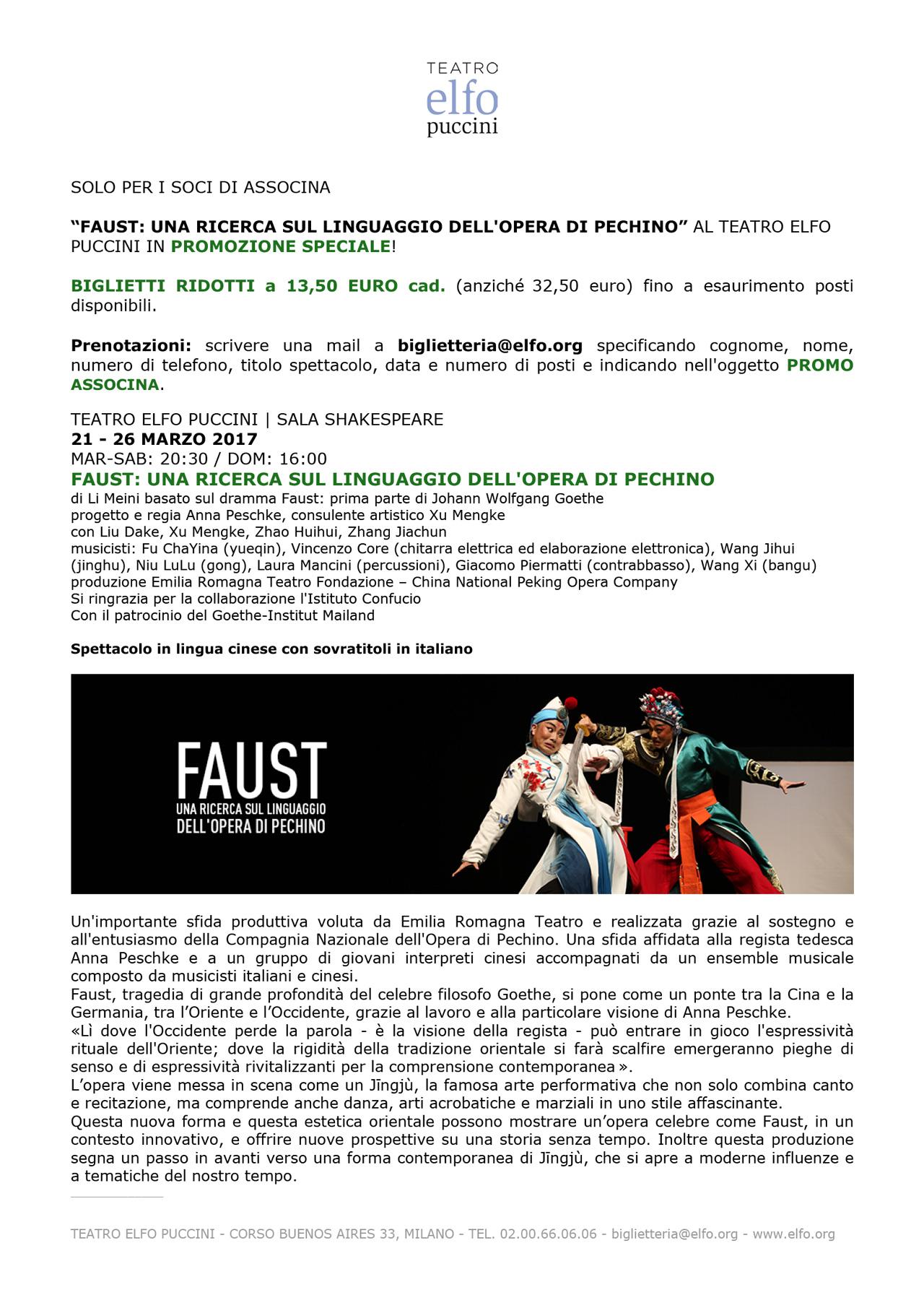
A major production challenge undertaken by Emilia Romagna Teatro and made possible thanks to the support and enthusiasm of the China National Peking Opera Company. A challenge entrusted to German director Anna Peschke and a group of young Chinese performers accompanied by a musical ensemble of Italian and Chinese musicians.
Faust, a tragedy of great depth by the celebrated philosopher Goethe, stands as a bridge between China and Germany, between East and West, thanks to the work and particular vision of Anna Peschke.
«Where the West loses its words - in the director's vision - the ritual expressiveness of the East can come into play; where the rigidity of Eastern tradition is scratched, folds of meaning and expressiveness will emerge that revitalise contemporary understanding».
The work is staged as a Jīngjù, the famous performing art that not only combines singing and acting, but also includes dance, acrobatics and martial arts in a captivating style.
This new form and this Eastern aesthetic can present a celebrated work like Faust in an innovative context and offer new perspectives on a timeless story. This production also marks a step forward towards a contemporary form of Jīngjù, open to modern influences and themes of our time.
Download the PDF flyer at: Newsletter Associna Faust